According to Bernards Shillman´s “A Short History of the Jews in Ireland”, the first Jewish immigrants to Ireland can be traced back to 1232, shortly after the Anglo-Norman invasion but were expelled in 1290 from Great Britain and Ireland.
The Jewish people that immigrated to Ireland in the 19th and 20th century, were mainly Lithuanian Jews, that were trying to escape the rise in pogroms and were forced to leave their homes and countries. According to Ray Rivlin´s “Jewish Ireland, A Social History”, the census in 1881 listed only 394 Jews in the whole of Ireland. Jews that were searching for refuge, tired reaching countries such as South Africa, Canada, England, Palestine and America.
To many, Ireland as their end destination, came as a surprise. Believing Cork to be New York, and some, who only had enough money for their journey to Ireland, were removed from the ship and were forced to stay in Ireland.
An example of this is Nick Harris, author of the book “Little Jerusalem”, whose parents, Israel Bernard and Edith Chachanoff, arrived in England in the early 1900s, believed they were in America, decided to move to Dublin and stay.
While the Jewish people were fleeing the persecution, their arrival in Ireland brought a range of reactions. Some Irish people met the new strangers, that spoke Yiddish and Russian, with indifference and resentment. Others showed kindness and helped. The authorities, who showed kindness even provided a section of the Tara Street baths, as a place for the Jewish community to use as their ritual baths, the mikvah.
Life in the Jewish community
While the number of Jews that lived in Dublin by the turn of the century amounted to 2048, according to Dermot Keogh´s book “Jews in Twentieth-Century Ireland”, published April 30th, 1998, they led safe and sheltered lives, away from the terrors of Nazi Germany.
Little Jerusalem, which was the heart of the Jewish community in Dublin, was located on Clanbrassil Street, on the South Circular Road. Clanbrassil Street, at the time, was filled with Jewish grocery stores, Jewish butchers and Jewish bakeries. Little Jerusalem was the place were the Jewish community met outside and shared the latest news on births, weddings and burials.
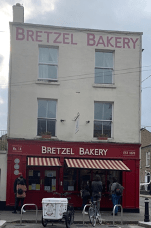
The Bretzel Bakery, which was previously known as Clein´s Bakery, opened its doors in 1920 at 1A Lennox Street, and was one of several Jewish bakeries that supplied the community with kosher bread and pastries.
In 1964, Christy Hackett, who was the head baker´s assistant, a gentile, rented the bakery and changed its name. Following the owner’s death in 1996, Hackett´s son bought the bakery and although ownership has changed, the bakery is still in business today.
Spread around the community, were multiple synagogues. The Dublin Hebrew Congregation, in 12 Mary´s Abbey, which was founded in 1839, moved to Adelaide Road in 1892, as with the immigration of the Lithuanian Jews, they needed a new location.
From the day the doors to Adelaide Road Synagogue were opened, the community celebrated many weddings as well as the Bar Mitzva of Israel´s future president, Chaim Herzog.
Rabbi Isaac Herzog was born in Lomza, Poland, in 1889. He lived in Belfast before moving to Dublin, and was seen by the community as their spiritual leader
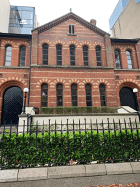
The Herzog family moved to Dublin in 1919 and lived on the South Circular Road before moving to a house in Bloomfield Avenue. Dr. Isaac Herzog, who served as chief rabbi, married Sarah Hillman in 1917 and had two sons, Chaim and Jacob. Both their sons chose political carriers. Jacob became a diplomate and later a senior adviser of Prime Minter Levi Eshkol. Adelaide Road Synagogue has since closed its doors in 1999 and moved to Rathfarnham Road, where the congregation was renamed Dublin Hebrew Congregation.
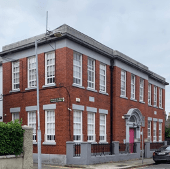
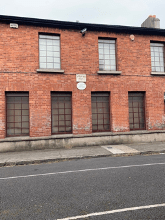
While the Herzog’s resided in the heart of “Little Jerusalem”, Bloomfield Avenue also had a Jewish school which was attended by both girls and boys.
Today the Jewish community as such has shrunk. Little Jerusalem no longer has its Jewish shops or the Jewish people running around, getting ready for the feasts and the shabbat. As many Jews left Ireland, following the end of World War II, many resettled in Israel but also America.
Much of what was no longer exists, the Irish Jewish Museum, which opened its doors in 1985, serves as a great place to learn about the past life of Clanbrassil Street.
By Adina Sarah Abraham
 Adina Sarah Abraham