“Companies like Facebook should not be allowed to behave like ‘digital gangsters’ in the online world, considering themselves to be ahead of and beyond the law” (UK’s Digital, Culture, Media and Sport Committee report on Disinformation and ‘fake news’, 2019).
(Credit: Phone Screenshot of Facebooks website, taken from Adina Sarah Abraham´s phone on February 7th 2021)
Chief executive and founder of Facebook, Mark Zuckerberg, stated before Congress in April 2018 the following:
“Facebook is an idealistic and optimistic company. For most of our existence, we focused more on all of the good that comes from connecting people can do. And as Facebook has grown, people everywhere have gotten powerful new tools for staying connected to the people they love, for making their voices heard and building communities and businesses.”
Facebook was created on February 4th 2004 and now, nearly twenty years later, with over two billion users worldwide and over 70.7 billion in revenue as of 2019, Facebook has grown to become the largest social media platform of our time, making 90 percent of their profit by running ads. Having bought Instagram in 2012 and WhatsApp in 2014, Facebooks influence and power has evolved to be a monopoly, overrunning and crushing any competition in near sight.
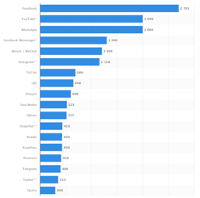
Global social networks ranked by number of users 2020 Published by H. Tankovska, Jan 28, 2021)
In an article, published by the New York Times on May 9th 2019, former employee and co-founder, Chris Hughes, stated that: “of every dollar spent buying ads on social media, $0.84 USD go to Facebook.” What set out to be a simple communications platform, that connected Harvard students in 2004, has since expanded worldwide and has turned into a money-making advertising agency that has created new jobs and helped many businesses. With offices all over the world, of which multiple are subsidiaries. Facebook employed in December 2019 over 44942 people, according to Statistica.

Credit: Number of Facebook employees 2004-2019 Published by H. Tankovska, Jan 27, 2021
Hughes, who left Facebook in 2007, made his views public and called on the government to regulate Facebook. In his article he called for the company to be broken up and the acquisitions of Instagram and WhatsApp to be reversed as the power Zuckerberg exerts is:
“unchecked, far beyond that of anyone else in the private sector or in government”, according to Hughes.
Well aware that in the past the government regulated corporate empires, the call to breakup the company comes as a way to guarantee that smaller companies will be able to compete in a market that is highly dominated by tech companies such as Facebook, Google, Twitter, Apple and Amazon.
The call to regulate has since grown, following the data breach scandal, after it became apparent, that a UK professor by the name of Alexandr Kogan, created a quiz app of personality traits that was sent to 300.000 American Facebook users, of which 270.000 participated. By taking the quiz, participants were asked to log into their Facebook accounts. Using the algorithms Facebook is running their business model with, Kogan was able to access the personal data of the users, such as their date of birth, their likes and their locations.
With the data obtained, he was able to create personal profiles for each user and send tailored political ads that in retrospect impacted the 2016 elections as the consultancy firm, Cambridge Analytica, was running the election campaign for Donald Trump, partnered with Kogan and bought the data.
The data collected not only gave access to the participants of the quiz, but also gave access to all their friends. This amounted to the data of 87 million Facebook users without their consent.
To the surprise of many Donald Trump won the elections and became the 45th US president.
Following the scandal, Zuckerberg, who rejected any notion that Facebook influenced the elections, was invited to appear before Congress in Capitol Hill and testify about Facebooks involvement in April 2018.
As he appeared at Capitol Hill, accompanied by four of his advisers, who sat behind him during the hearing, Zuckerberg was asked to give account and explain Facebook´s responsibility. Senator John Thune, who began the hearing, gave a brief explanation on why Zuckerberg was invited, stating:
“The reason why people are worried about the incident is what it says about how Facebook works.” Thune began, “The idea that for every person that decides to try an app, information about nearly 300.000 users were scraped form your services. That fact that 87 million users may have consented to the privacy settings does not make it right or make people feel better.
The recent revelation that malicious actors were able to utilize Facebooks default privacy settings to match email addresses and phone numbers found on the so call `Dark Web´ to public Facebook profiles, affecting Facebook users, only adds fuel to the fire.
Typical breaches do not happen this way usually. This is a result of people exploiting the very tools that you have created to manipulate user information.”
“Most of us understand that whether you are using Facebook, Google or some other online service, we are trading certain information about ourselves for free or low-cost services. But for this business model to persist, both sides of the barging need to know the stakes that are involved.
Right now, I am not sure that Facebook users have the right information that they need to make meaningful choices.”
Senator Thune, continued by asking Zuckerberg, to give account on the ways Facebook and other tech companies were planning to take greater responsibility for what happens on their platforms.
“How will you protect users data? How will you inform users about the changes that are being made? And how do you proactively stop harmful conduct instead of being forced to respond to it months or years later?”
Senator Dianne Feinstein followed, stating that this hearing served as a “real opportunity to protecting individual privacy.” “We have learned, that over the past few months, how foreign actors abuse social media platforms like Facebook, to interfere in elections and take millions of American´s personal information without their knowledge.
In order to manipulate public opinion and target individual voters.”, according to Feinstein. In her end statement she voiced her concern, that Facebook knew about the data breach already in 2015 but did not take any appropriate action until 2018. She concluded, expecting Facebook to regulate and reform the platforms they control.
Senator Charles Grassley advised on the separate hearing exploring Cambridge and other data privacy issues that would take place. According to Grassley, the “events ignited a larger discussion on consumers expectations and the future of data privacy in our society. Consumers may not fully understand or appreciate the extent to which their data is collected, protected, transferred, used and misused.”
He went on to state: “Data has been used in advertising and political campaigns for decades. The amount and type of data obtained however has seen a very dramatic change. Campaigns, including presidents Bush and Obama, all used these increasing amounts to focus on micro targeting and personalization over numerous social media platforms and especially Facebook.
In fact, president´s Obamas campaigns developed an app using the same Facebook feature as Cambridge Analytica’s, to capture the information of not just the app users but millions of their friends.
The digital director for that campaign in 2012, described the data scrapping app, that would “wind up being the most ground-breaking piece of technology developed through this campaign.
“Our policy towards data privacy and security must keep pace with these changes. Data privacy should be tethered to consumer needs and expectations.”
“The tech industry has an obligation to respond to the widespread and growing concern over data privacy and security and to restore the public’s trust. The status quo no longer works”, according to Senator Grassley.
Following the senators introduction, Mark Zuckerberg began by stating:
“We face a number of important issues around privacy, safety and democracy. And you all rightfully have some hard questions for me to answer.”
Promising to conduct a full review of what happened and vowing that a breach of privacy to this extend would never happen again, Zuckerberg ensured that Facebook would investigate all app developers that had access to large amount of data in the past as well as limiting the data available to new app developers that offer their services over Facebook.
Now nearly three years after the hearing and with a new president in the White House, Facebook has remained self-regulated. Following the hearing in 2018, Zuckerberg decided to install an oversight board that would focus on challenging content issues, such as hate speech and harassment which would be governed by 20 members that hold a different political views.
While there have not been any new reports on data breaches, the Cambridge Analytica scandal was not the first incident. On November 29th 2011, the FTC released a report advising that they had reached an agreement with Facebook, as it was charged for “deceiving consumers by failing to keep privacy promises.”
According to the report, Facebook made several promises it did not keep, such as inform its users that the privacy settings, which were hidden, were now made public.
Furthermore, users were deceived to believe that developers of third-party would only have access to the information they needed to operate with. But in truth app enabled the developers to access all of the users personal data. These are only few examples.
Speaking to Nick Davis, author and former journalist for the Guardian, when asked if social media should be regulated.
“These platforms have become the primary way we communicate with each other, but they are not in our control. As they are privately owned, and users communicate in ways dictated by their owners.
It is impossible to place a set of rules to silence those that abuse freedom of speech as these would also be placed on users that are in no way offensive. To come up with an effective rule, you have to confront the very difficult subject of agreeing that some opinions are not legitimate.
The best approach is to stop trying to police opinion and to focus instead on correcting falsehood. The long-term solution would be to institutionalize and tax social media companies. The tax money should be added to a Fund for Journalism which would be given to media organisations that meet the standards such as checks facts, corrects falsehoods and most importantly abides by ethical rules.”, according to Davis.
When asked if Facebook viewed itself above the law, Davies stated:
“Facebook, like most multinational corporations, certainly views itself as being above tax law and hires clever accountants and specialist lawyers to find loopholes in the law so that it can avoid paying the huge amounts of money which democratic assemblies had intended them to pay in tax. This is terribly damaging for all of us. So far as the information on its platform is concerned, I wouldn’t say that Facebook thinks itself above the law.”
According to Davies, the truth lies in the fact that Zuckerberg and all parties involved assumed, that they could make fortunes without counting the costs or addressing the issues of the information chaos they encouraged.
Today, as they are being forced to find solutions and answers to the data privacy issues, they struggle, as they are not clever enough, according to Davies.
By Adina Sarah Abraham
 Adina Sarah Abraham