I had the privilege to speak to a man on the phone, that decided to quit his job, even refuse a promotion and begin a journey to places he never before visited and meet people he never met before.
His name is Ümit Yücel.
Born and raised in Gelsenkirchen, Ümit always dreamed of seeing as many countries as possible.
In 2014, while living in Dublin, he became good friends with his housemate Khaled, and after both discovered their mutual love and joy for travelling, decided to travel North and South America.
In the span of five and a half months they were able to visit Peru, Brazil, Argentina, Bolivia, Chile and many more countries. They concluded their journey in France and celebrated its successful ending on December 31st, 2016.
As their adventure ended both went their separate ways. Ümit returned to Germany where he stayed for the next three months, enjoying his family, as he had spent the last three years apart from them.
He did not have everything figured out but when a new job opportunity presented itself, he took it. He moved to Amsterdam and began a new chapter in his life.
For the next year and a half, he worked and just lived his life. But as time passed by, he realized this was not the life he envisioned for himself.
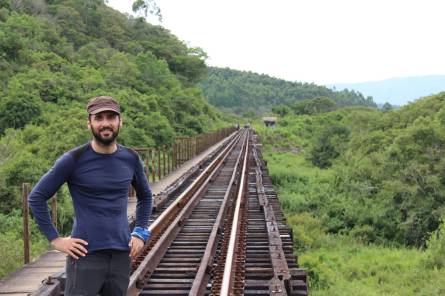
The Photo was taken by ÜmitThe Photo was taken by Ümit
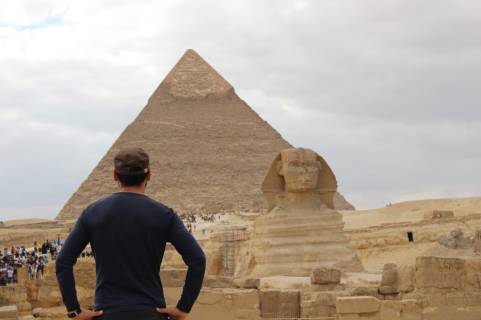
Being inspired by the story of a young shepherd who leaves everything behind to follow a night vision he had over a hidden treasure buried underneath Pyramids. The young shepherd finds the treasure by the end of the story but learns the most valuable life lesson.
Dreams can only be achieved once you go after them…
With this positive attitude in mind Ümit reached out to his friend Khaled and both began to plan their “World Trip”. Their plan was to start off in Africa and from there travel to Europe and take the Trans-Siberian railway through Russia and fly out to South Korea and China.
Being mindful of the costs involved they chose to use the accommodations offered on couch surfing. Knowing that this would be a quicker way to meet locals and learn about their culture.
And so, after quitting his job, leaving his apartment and storing his belongings at his parents’ house, Ümit flew in October 2018 from Düsseldorf to Barcelona and from there to Algeria.
The day I spoke to him he shared, that he suffered food poisoning after eating a new dish. But he recovered. Khaled and he had reached Zambia and were getting ready for the next stage in their journey. Taking the train from Kapiri Mposhi in Zambia to Dar es Salaam in Tanzania.
After reaching Tanzania, Ümit let me know that their train was derailed and what should have taken them three days and two nights took them five days.
Their journey did not end there. Like the young shepherd in the story, Ümit was able to reach the pyramids.
Sexual violence has already been known to be a worldwide issue that at times may have been addressed too little by authorities around the world. It has impacted the lives of millions of people, even so in India. With a population of over one billion, human trafficking, gendercide and forced labour have been exposed but the desired change seems to be missing.
According to findings by the United Nations Office on Drugs and Crime which was conducted in 2018, adult women account for nearly half, 49 percent, of all human trafficking victims detected globally. Women and girls together account for 79 percent, with girls representing more than three out of every four child trafficking victim. More than four out of every five trafficked woman and nearly three out of every four trafficked girl, is trafficked for the purpose of sexual exploitation.
The WHO has released findings in which it is assumed that 35 percent of women worldwide have experienced either physical and sexual intimate partner violence or non-partner sexual violence.
Women who have been physically or sexually abused by their partner report higher rates of a number of important health problems. These women are 16 percent more likely to have a low birth-weight baby. They are more than twice as likely to have an abortion and twice as likely to experience depression. In some regions these women are more likely to have been infected by HIV in comparison to women who have not experienced partner violence.
In the film documentary “It´s a Girl”: The Three Deadliest Words in the World from 2012, documentary maker Evan Grae Davis, addresses this issue. In his documentary, Davis initially sought out to expose sexual trafficking and raise awareness, but after speaking to several women, changed the his focus, as he became aware of a more crucial subject. Gendercide. A practice that western countries may not be too familiar with, but which has impacted the entire world.
According to the United Nations Population Fund of 2020 it is now estimated that 143 million, around 3.7%, of women worldwide are missing today as a result of sex-selective abortions, female infanticide, gross neglect of young girls, entirely preventable maternal death and the inability of older women to access food and shelter. As well as socially sanctioned violence against women. I sat down with Beverly Hill, founder and president of the Gendercide Awareness Project, who has been, for the last several years, vocal and active to raise awareness of the deliberate extermination of women based on their gender.
In early 2004, on what would have been a relaxing afternoon at a café, Hill discovered the horrors of the Sex Trafficking Industry. After reading a published article titled “The Girls Next Door” by Peter Landesman in the New York Times Magazine, her life mission and desire to protect and raise awareness on the horrors of sexual violence against women was born.
Landesman’s findings brought a wave of shock as his discovery mirrored the seemingly silent world that by the looks of it ignored and turned away from the scene. His findings highlighted the great power people involved truly have. The Victims of Trafficking and Violence Act of 2000, which was introduced in 2000 by the Bush administration, has since been renewed five times but has not changed much of the circumstances. Countless cases have been mentioned in which victims sought support and protection from the police only to discover that the police were in collusion with the brothels they escaped.
Landesman’s article may have primarily focused on the United States, Mexico and Russia but the impact of this issue reaches far beyond. Countries like India and China have to this day the largest populations and the consequence of Gendercide are felt there the most.
According to Hill, women of all ages suffer tremendously as these traditional societies generate wealth to their sons instead of to their daughters. Widows are oftentimes neglected after their husbands die and are unable to take care of themselves. In many cases their daughters have married outside their village, leaving behind old parents with the burdensome duty to pay off their dowry and with no provision.
For fear of these high dowry costs, it has been a common practice to murder daughters after birth, as mentioned in the film documentary “It’s a Girl”. Many pregnant women were forced to sex selective abortions by their husbands and in-laws.
In an effort to change India’s perception on daughters, several initiatives have been formed by the government. Under the leadership of prime minister Dr. Manmohan Singh, billboards and add campaigns were brought up that asked families to keep their daughters. The government offered financial aid to support families which would have been used as a deposit for their daughters’ future wedding.
The aftermath of these long-practiced customs have left large portions of the society with skewed sex ratios that have in turn become sex trafficking hot spots.
In past interviews Hill addressed this issue and explained that the North-West provinces in India have the most skewed sex ratios in the world. Many women and girls have been trafficked from Nepal, lured under false pretence with job opportunities as maids. These girls wake up in brothels to a new realty they never would have imagined.
As a result of poor law enforcement and collusion between the police and the brothels, women that try to escape are caught and brought back beaten and intimidated to prevent them and others from escaping. In many instances these women are completely lost unable to get back to their families as they do not know in what part of the country they are located.
The dilemma does not stop here, due to their skewed sex ratios many women are sold as brides on so called “black markets”. In many instances underage girls who have not even reached the age of puberty are raped by their older husbands. Often times these young girls have, as a result of this, damaged bodies or die during childbirth.
Worldwide initiatives to change and bring a stop to sexual violence have not been addressed enough. India’s new leadership under Modi, has made it very difficult for foreign NGO´s such as the Gendercide Awareness Project. According to Hill, there have been several initiatives to bring the Gendercide Awareness Project’s Art installation of baby booties to India, but all plans were brought to a hold as Hill was unable to find the approval and support from the government.
In total 12.600 baby botties were handmade by several women in collaboration with the Gendercide Awareness Project, each representing 10,000 missing women.
In light of the annual European Commission Award competition students attended this years’ workshop from the comfort of their homes.
Students were invited to attend the European Commission SMEDIs workshop which was hosted by European Movement Ireland. Guest speakers included Chrstina Bohan, from the Journal.ie, Grace Bolton, Head of Press European Commission in Ireland, as well as this year’s winner, Elisha Carey.
The workshop served as an opportunity for students to join and meet people from the media industry and receive insight into the daily routines of a newsroom and press conferences at the European Union in Brussels.
The workshop took place on November 17th ,2020 and was held over Zoom due to COVID-19 restrictions.
Attendees were encouraged to participate in the annual writing competition by the European Commission that would guarantee the winners article to be published in an Irish newspaper and receive a 1000 Euro winning check.
As one of the guest speakers, this year’s European Commission Award winner, Elisha Carey, shared on her writing experience and the process behind choosing the right subject to write on. In her article, she chose to reflect on her European Identity and her study experience as part of the Erasmus program abroad.
Believing she would not make any friends, Carey, was pleasantly surprised to discover that her views and life experiences were similar to those she met during her time abroad.
Reflecting on her study experience, she felt privileged to be a European citizen and been given this opportunity to live and study in a new country such as the Netherlands.
As the guest speakers shared on their professional lives, all attendees were encouraged to participate and ask their questions.
Christina Bohan gave insight on the different ways she and her colleagues entered the field of journalism, emphasizing the importance of soft skills within a team as a crucial element.
Bohan who is the current deputy editor at the Journal.ie, has also been running the fact checking project for the online newspaper.
According to her, social media platforms such as Facebook or Twitter, are not to be viewed as news outlets, as these mainly focus on their own business agendas and do not serve as allies but as competitors that have great influence.
When asked on how journalism evolved, she stated that there had been a “shift away from speed” and that “journalism is not changing but that journalism is being presented in a different way”, according to Bohan.
The workshop concluded with Grace Bolton, Head of Press European Commission in Ireland, providing an insightful glance on the European Union and the different functions of the governing bodies starting with the European Council down to the European Parliament.
In light of the SMEDIs competition, Bolton provided ideas and topics the students could choose when writing their articles.
“Companies like Facebook should not be allowed to behave like ‘digital gangsters’ in the online world, considering themselves to be ahead of and beyond the law” (UK’s Digital, Culture, Media and Sport Committee report on Disinformation and ‘fake news’, 2019).
(Credit: Phone Screenshot of Facebooks website, taken from Adina Sarah Abraham´s phone on February 7th 2021)
Chief executive and founder of Facebook, Mark Zuckerberg, stated before Congress in April 2018 the following:
“Facebook is an idealistic and optimistic company. For most of our existence, we focused more on all of the good that comes from connecting people can do. And as Facebook has grown, people everywhere have gotten powerful new tools for staying connected to the people they love, for making their voices heard and building communities and businesses.”
In an article, published by the New York Times on May 9th 2019, former employee and co-founder, Chris Hughes, stated that: “of every dollar spent buying ads on social media, $0.84 USD go to Facebook.” What set out to be a simple communications platform, that connected Harvard students in 2004, has since expanded worldwide and has turned into a money-making advertising agency that has created new jobs and helped many businesses. With offices all over the world, of which multiple are subsidiaries. Facebook employed in December 2019 over 44942 people, according to Statistica.
Hughes, who left Facebook in 2007, made his views public and called on the government to regulate Facebook. In his article he called for the company to be broken up and the acquisitions of Instagram and WhatsApp to be reversed as the power Zuckerberg exerts is:
“unchecked, far beyond that of anyone else in the private sector or in government”, according to Hughes.
Well aware that in the past the government regulated corporate empires, the call to breakup the company comes as a way to guarantee that smaller companies will be able to compete in a market that is highly dominated by tech companies such as Facebook, Google, Twitter, Apple and Amazon.
The call to regulate has since grown, following the data breach scandal, after it became apparent, that a UK professor by the name of Alexandr Kogan, created a quiz app of personality traits that was sent to 300.000 American Facebook users, of which 270.000 participated. By taking the quiz, participants were asked to log into their Facebook accounts. Using the algorithms Facebook is running their business model with, Kogan was able to access the personal data of the users, such as their date of birth, their likes and their locations.
With the data obtained, he was able to create personal profiles for each user and send tailored political ads that in retrospect impacted the 2016 elections as the consultancy firm, Cambridge Analytica, was running the election campaign for Donald Trump, partnered with Kogan and bought the data.
The data collected not only gave access to the participants of the quiz, but also gave access to all their friends. This amounted to the data of 87 million Facebook users without their consent.
To the surprise of many Donald Trump won the elections and became the 45th US president.
As he appeared at Capitol Hill, accompanied by four of his advisers, who sat behind him during the hearing, Zuckerberg was asked to give account and explain Facebook´s responsibility. Senator John Thune, who began the hearing, gave a brief explanation on why Zuckerberg was invited, stating:
“The reason why people are worried about the incident is what it says about how Facebook works.” Thune began, “The idea that for every person that decides to try an app, information about nearly 300.000 users were scraped form your services. That fact that 87 million users may have consented to the privacy settings does not make it right or make people feel better.
The recent revelation that malicious actors were able to utilize Facebooks default privacy settings to match email addresses and phone numbers found on the so call `Dark Web´ to public Facebook profiles, affecting Facebook users, only adds fuel to the fire.
Typical breaches do not happen this way usually. This is a result of people exploiting the very tools that you have created to manipulate user information.”
“Most of us understand that whether you are using Facebook, Google or some other online service, we are trading certain information about ourselves for free or low-cost services. But for this business model to persist, both sides of the barging need to know the stakes that are involved.
Right now, I am not sure that Facebook users have the right information that they need to make meaningful choices.”
Senator Thune, continued by asking Zuckerberg, to give account on the ways Facebook and other tech companies were planning to take greater responsibility for what happens on their platforms.
“How will you protect users data? How will you inform users about the changes that are being made? And how do you proactively stop harmful conduct instead of being forced to respond to it months or years later?”
Senator Dianne Feinstein followed, stating that this hearing served as a “real opportunity to protecting individual privacy.” “We have learned, that over the past few months, how foreign actors abuse social media platforms like Facebook, to interfere in elections and take millions of American´s personal information without their knowledge.
In order to manipulate public opinion and target individual voters.”, according to Feinstein. In her end statement she voiced her concern, that Facebook knew about the data breach already in 2015 but did not take any appropriate action until 2018. She concluded, expecting Facebook to regulate and reform the platforms they control.
Senator Charles Grassley advised on the separate hearing exploring Cambridge and other data privacy issues that would take place. According to Grassley, the “events ignited a larger discussion on consumers expectations and the future of data privacy in our society. Consumers may not fully understand or appreciate the extent to which their data is collected, protected, transferred, used and misused.”
He went on to state: “Data has been used in advertising and political campaigns for decades. The amount and type of data obtained however has seen a very dramatic change. Campaigns, including presidents Bush and Obama, all used these increasing amounts to focus on micro targeting and personalization over numerous social media platforms and especially Facebook.
In fact, president´s Obamas campaigns developed an app using the same Facebook feature as Cambridge Analytica’s, to capture the information of not just the app users but millions of their friends.
The digital director for that campaign in 2012, described the data scrapping app, that would “wind up being the most ground-breaking piece of technology developed through this campaign.
“Our policy towards data privacy and security must keep pace with these changes. Data privacy should be tethered to consumer needs and expectations.”
“The tech industry has an obligation to respond to the widespread and growing concern over data privacy and security and to restore the public’s trust. The status quo no longer works”, according to Senator Grassley.
Following the senators introduction, Mark Zuckerberg began by stating:
“We face a number of important issues around privacy, safety and democracy. And you all rightfully have some hard questions for me to answer.”
Promising to conduct a full review of what happened and vowing that a breach of privacy to this extend would never happen again, Zuckerberg ensured that Facebook would investigate all app developers that had access to large amount of data in the past as well as limiting the data available to new app developers that offer their services over Facebook.
Now nearly three years after the hearing and with a new president in the White House, Facebook has remained self-regulated. Following the hearing in 2018, Zuckerberg decided to install an oversight board that would focus on challenging content issues, such as hate speech and harassment which would be governed by 20 members that hold a different political views.
While there have not been any new reports on data breaches, the Cambridge Analytica scandal was not the first incident. On November 29th 2011, the FTC released a report advising that they had reached an agreement with Facebook, as it was charged for “deceiving consumers by failing to keep privacy promises.”
According to the report, Facebook made several promises it did not keep, such as inform its users that the privacy settings, which were hidden, were now made public.
Furthermore, users were deceived to believe that developers of third-party would only have access to the information they needed to operate with. But in truth app enabled the developers to access all of the users personal data. These are only few examples.
Speaking to Nick Davis, author and former journalist for the Guardian, when asked if social media should be regulated.
“These platforms have become the primary way we communicate with each other, but they are not in our control. As they are privately owned, and users communicate in ways dictated by their owners.
It is impossible to place a set of rules to silence those that abuse freedom of speech as these would also be placed on users that are in no way offensive. To come up with an effective rule, you have to confront the very difficult subject of agreeing that some opinions are not legitimate.
The best approach is to stop trying to police opinion and to focus instead on correcting falsehood. The long-term solution would be to institutionalize and tax social media companies. The tax money should be added to a Fund for Journalism which would be given to media organisations that meet the standards such as checks facts, corrects falsehoods and most importantly abides by ethical rules.”, according to Davis.
When asked if Facebook viewed itself above the law, Davies stated:
“Facebook, like most multinational corporations, certainly views itself as being above tax law and hires clever accountants and specialist lawyers to find loopholes in the law so that it can avoid paying the huge amounts of money which democratic assemblies had intended them to pay in tax. This is terribly damaging for all of us. So far as the information on its platform is concerned, I wouldn’t say that Facebook thinks itself above the law.”
According to Davies, the truth lies in the fact that Zuckerberg and all parties involved assumed, that they could make fortunes without counting the costs or addressing the issues of the information chaos they encouraged.
Today, as they are being forced to find solutions and answers to the data privacy issues, they struggle, as they are not clever enough, according to Davies.
“I was 11 years old when I returned to school, my classmates were two to three years younger. They bullied me as they did not understand what had happened to me and why I had to learn everything again.”,
Tomi Reichental and Adina Sarah Abraham on November 3rd 2020,, taken during the interview
After being head hunted by an Italian engineering company at the age of 24, Tomi Reichental began his new life in Ireland. Now he shares his story.
It was 1940, at the age of nine, when Tomi Reichental was deported to Bergen Belsen. He was born in a small village in Slovakia to Jewish parents. Life was idyllic, as his father, a well-respected farmer was able to provide a comfortable life for his family.
Recalling his memory, he remembers that his childhood was sheltered and safe. All of their dealings in life, whether it be doctor visits or legal matters, revolved in their Jewish community. As Jews were not allowed to work in all professions, the Jewish community thrived and supported each other making each other succeed.
This led to jealousy and rivalry with some of the Slovakian people. As he grew up, surrounded by his family, Tomi was sheltered from the growing persecution in the late 1930´s and early 1940´s. This changed as the Slovakian government, under leadership of Jozef Tisco, instated by the German government, introduced new laws that restricted the lives of all Slovakian Jews, removing them from public and governmental positions.
As restrictions were placed, forbidding Jews from attending national schools, parks and other public places, restrictions were also placed on the amounts of money they were allowed to withdraw from their bank accounts.
The government slowly but surely sympathized with the Nazi regime, stripping the Jews of their Slovakian nationality and forcing them to wear a yellow Star of David.
The main outlet and platform that was used to further new agendas came straight from the pulpits of Roman-Catholic churches.
The first wave of deportations started in March 1942 and lasted until October 1942. And for six months, almost all Slovakian Jews were deported to concentration camps, mainly Auschwitz, where they were gassed and burned.
It is estimated that only 25000 Slovakian Jews survived the Holocaust, among them Tomi, his brother, mother, aunt and father. All other 35 family members perished.
While trying everything in their power to stop the deportation of Jewish people, the Jewish community began to collect money with which they were able to bribe some of the Slovakian officials who were hired by the Nazis to find and arrest Jews. As not all the Slovakians supported the government under Tisco, the Jewish community found some support in their resistance. This ended once the Gestapo invaded Slovakia.
As the second deportation wave began in August 1944, Reichental´s parents believed it was best to leave their village and take on new identities, while Tomi´s father stayed behind to work the farm and provide for his wife and children. Their escape was supported by a priest who provided papers as they had to leave their names behind.
And for a few weeks all was well, but this changed as Tomi´s father, betrayed by a police guard that knew the family very well, arrested him.
“My father and two other men were able to jump off the train that would have brought them to Auschwitz.”
Not knowing whether they would see him again, their own safety was in danger as police officers questioned Tomi and his brother at a small shop. Wearing their Gestapo uniform, the police offices began intimidating the boys, demanding of them to confess their Jewish identity.
Both children denied, knowing very well that their life was in danger, but confessed as the officers did not stop their interrogation. At the time Tomi was only nine and his brother thirteen.
“My brother was always very protective of me. And once he saw that they began to hit me, he confessed.”
As both admitted their identity, they were brought down to the Gestapo headquarters, where they met the rest of their arrest family, among them their mother and grandmother.
After the selection by one of the Gestapo officers, the group was split into two groups, of which some were deported to Sachsen-Anhalt and the rest to Bergen Belsen.
And on November 2nd 1944, Tomi, his brother, mother, aunt and grandmother boarded the train that would have brought them on November 9th 1944 to Bergen Belsen.
Life in Bergen Belsen was cruel. The inhuman conditions the inmates were exposed to, have to this day, been part of his life. Remembering the stain and smell of the dead corpses lying around the camp, Tomi recalls, that this was a condition all inmates had no other choice but to accept.
“We were playing, eating and living around the dead bodies. The smell was terrible.” He recalls.
Their daily provision was scarce as the SS officers provided three meals a day which contained, two slices of bread in the morning with a cup of coffee, a soup during lunch and two slices of bread in the evenings.
Without any personal hygiene, the inmates suffered of Typhus which was carried by lice and other insects that infiltered the camp, causing a surge in deaths.
By April 15th 1945, the British liberated the camp and the Red Cross took care of all the inmates.
Eventually they were able to leave and return to their village, as they received message by Tomi´s father, that he was waiting for them at their home.
To their great surprise, their home had not been demolished as one of the SS officers had resided there.
As they returned to their village, Tomi returned to school, having lost his basic education he had to restart and learn everything from scratch,
“I was 11 years old when I returned to school, my classmates were two to three years younger. They bullied me as they did not understand what had happened to me and why I had to learn everything again from the beginning.”he recalls.
Unable to forget their past experience, the Reichental´s decided to immigrate to Israel in February 1949 alongside other Holocaust survivors and start over.
Now, over 75 years after Bergen Belsen was liberated, Reichental is inviated to many places to share his story and the story of so many others that never had the chance to live out their lives.
“Holocaust did not start with gas chambers, it started with whispers and abuse”, according to Reichental during a speech at UCD in 2015. “Don´t be a bystander to bullying, get involved and tell them it is wrong. When it was happening to us, nobody stood up for us.”
He has accomplished much in life, running his own business, writing books, being married and taking care of his three sons. The aftermath of the Holocaust did not break him, but he chose to remain a living witness to the horrific result of silence to bullying, discrimination and abuse.
According to Bernards Shillman´s “A Short History of the Jews in Ireland”, the first Jewish immigrants to Ireland can be traced back to 1232, shortly after the Anglo-Norman invasion but were expelled in 1290 from Great Britain and Ireland.
The Jewish people that immigrated to Ireland in the 19th and 20th century, were mainly Lithuanian Jews, that were trying to escape the rise in pogroms and were forced to leave their homes and countries. According to Ray Rivlin´s “Jewish Ireland, A Social History”, the census in 1881 listed only 394 Jews in the whole of Ireland. Jews that were searching for refuge, tired reaching countries such as South Africa, Canada, England, Palestine and America.
To many, Ireland as their end destination, came as a surprise. Believing Cork to be New York, and some, who only had enough money for their journey to Ireland, were removed from the ship and were forced to stay in Ireland.
An example of this is Nick Harris, author of the book “Little Jerusalem”, whose parents, Israel Bernard and Edith Chachanoff, arrived in England in the early 1900s, believed they were in America, decided to move to Dublin and stay.
While the Jewish people were fleeing the persecution, their arrival in Ireland brought a range of reactions. Some Irish people met the new strangers, that spoke Yiddish and Russian, with indifference and resentment. Others showed kindness and helped. The authorities, who showed kindness even provided a section of the Tara Street baths, as a place for the Jewish community to use as their ritual baths, the mikvah.
Life in the Jewish community
While the number of Jews that lived in Dublin by the turn of the century amounted to 2048, according to Dermot Keogh´s book “Jews in Twentieth-Century Ireland”, published April 30th, 1998, they led safe and sheltered lives, away from the terrors of Nazi Germany.
Little Jerusalem, which was the heart of the Jewish community in Dublin, was located on Clanbrassil Street, on the South Circular Road. Clanbrassil Street, at the time, was filled with Jewish grocery stores, Jewish butchers and Jewish bakeries. Little Jerusalem was the place were the Jewish community met outside and shared the latest news on births, weddings and burials.
The Bretzel Bakery, which was previously known as Clein´s Bakery, opened its doors in 1920 at 1A Lennox Street, and was one of several Jewish bakeries that supplied the community with kosher bread and pastries.
In 1964, Christy Hackett, who was the head baker´s assistant, a gentile, rented the bakery and changed its name. Following the owner’s death in 1996, Hackett´s son bought the bakery and although ownership has changed, the bakery is still in business today.
Bretzel Bakery, Image taken by Adina Sarah Abraham
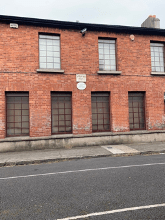
Spread around the community, were multiple synagogues. The Dublin Hebrew Congregation, in 12 Mary´s Abbey, which was founded in 1839, moved to Adelaide Road in 1892, as with the immigration of the Lithuanian Jews, they needed a new location.
From the day the doors to Adelaide Road Synagogue were opened, the community celebrated many weddings as well as the Bar Mitzva of Israel´s future president, Chaim Herzog.
Rabbi Isaac Herzog was born in Lomza, Poland, in 1889. He lived in Belfast before moving to Dublin, and was seen by the community as their spiritual leader
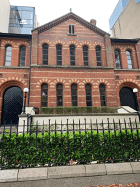
Adelaide Road Synagogue, Image taken by Adina Sarah Abraham
The Herzog family moved to Dublin in 1919 and lived on the South Circular Road before moving to a house in Bloomfield Avenue. Dr. Isaac Herzog, who served as chief rabbi, married Sarah Hillman in 1917 and had two sons, Chaim and Jacob. Both their sons chose political carriers. Jacob became a diplomate and later a senior adviser of Prime Minter Levi Eshkol. Adelaide Road Synagogue has since closed its doors in 1999 and moved to Rathfarnham Road, where the congregation was renamed Dublin Hebrew Congregation.
The former Jewish School, Image taken by Adina Sarah AbrahamThe Irish Jewish Museum, Image taken by Adina Sarah Abraham
While the Herzog’s resided in the heart of “Little Jerusalem”, Bloomfield Avenue also had a Jewish school which was attended by both girls and boys.
Today the Jewish community as such has shrunk. Little Jerusalem no longer has its Jewish shops or the Jewish people running around, getting ready for the feasts and the shabbat. As many Jews left Ireland, following the end of World War II, many resettled in Israel but also America.
Much of what was no longer exists, the Irish Jewish Museum, which opened its doors in 1985, serves as a great place to learn about the past life of Clanbrassil Street.
When Aiman Zafir Roslan (20) moved to Dublin in September 2017, he began a new journey. Now, a year later, he not only learned new things, but also grew into the roles entrusted to him. One of which being the president of the Malaysian Society at DBS. We sat down together and spoke about his life in Dublin as well as at Dublin Business School.
What made you come to Dublin?
I took my mother’s advice and moved to Dublin, so I could study at DBS and become an accountant. My mother thought Ireland would be the best place for me to live and study, since in Ireland, like Malaysia, many people with different nationalities and religions live here.
Has it always been your dream to become president of the DBS Malaysian Society?
I had already been part of the Malaysian Society when new DBS candidates for the new elections were picked. Once my name was mentioned I accepted the nomination and was pleasantly surprised to actually win. I did not plan it.
What do you think has made you stand out?
What made me stand out, I believe, was my speech. I spoke about the importance of being connected to each other. It is not just about events but about looking at ways to bring people together through events. I hope that, through my presidency, people will connect and remain connected.
What other societies do you connect with?
We recently worked together with DBS Film Society. They let us use their equipment, so we were able to screen a movie. I hope that in the long run, we will organize events with other Malaysian societies across colleges in Dublin. I know there is more to come.
What is the next upcoming event?
We will hold our next event on November 21st 2018 and will take place at Castle House. All societies will present their countries main dish.
Do you have any favorite Irish dish?
I love scones.
Have you changed much since moving to Dublin?
After spending the summer in Malaysia, my family noticed a change. I was told that I now consider others in my decisions and think less that the world revolves around me.
How has working with Adam and his team impacted your life?
Adam is such a great role model. He has helped me see life and situations through a different perspective. When I approach him with an idea he listens and offers great advice. I have grown in my confidence and improved my talents.
Are you planning to stay in Dublin?
Once I graduate I hope to get a job and stay here for few more years. My sister recently moved to Dublin as well, so we even get to spend some time together. But I am certainly planning to stay.







 Adina Sarah Abraham